
Imagine a morning like this. You put on a wristband, and the cursor settles on an email you want to open. You neither speak nor raise a hand. A reply that has not yet been written gradually appears on screen, through a series of choices and confirmations. In the evening, you remove the wristband and the system stops. It does not ask you to remain connected, or decide what is worth expressing on your behalf.
For a future brain–computer interface to become part of everyday life in this way, it must answer more than how to record more neural signals. It must also establish how it enters the body, how it can coexist with the body over time, and how it can leave when it is no longer wanted.
We call this proposed architecture VICON-BCI: Vascular-Guided Intravascular Chemical-Optical Neural BCI. It brings vascular access, flexible materials, optical interconnects and cybernetics into one design, with four ambitions: no craniotomy, no implanted battery, flexible optical connections, and materials designed with reversibility in mind.
This is a long-term concept grounded in specific areas of research, not a completed device, a clinical treatment or an implantation guide. The proposed optical network, wrist-level transceiver and chemical retirement mechanism have not been validated together. The illustrations and architecture diagrams are conceptual.
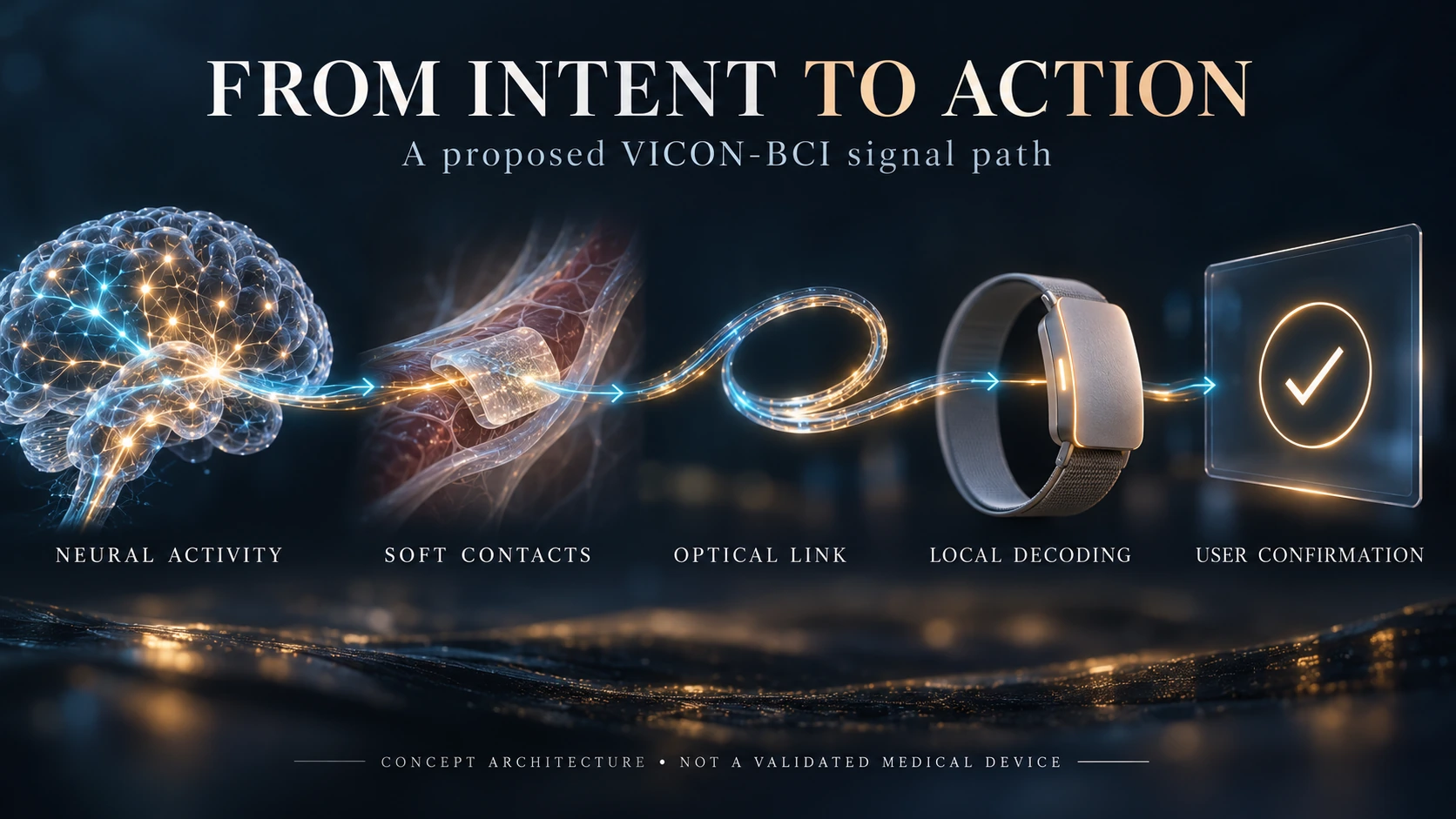
01 · Using blood vessels as an entry route
The brain contains a dense vascular network. That suggests an engineering question: could these existing channels carry sensors close to neural activity while reducing direct penetration of brain tissue? This approach has already moved beyond pure speculation.
The SWITCH study, published in 2023, followed four people with severe paralysis for twelve months after implantation of an endovascular brain–computer interface. Electrodes placed in a cerebral venous sinus supported digital switch control, combined with eye tracking for computer tasks. This small, early human study demonstrates that certain intravascular recordings can support interaction. It does not establish routine injection or whole-brain reading and writing. Original study: JAMA Neurology, 2023.
That same year, a study in Science reported the deployment of ultraflexible probes in blood vessels smaller than 100 micrometres in rodent brains, recording local field potentials and single-neuron activity. This extends the research into finer vessels, but cannot be extrapolated directly to a million-node network in human capillaries. Original study: Science, 2023.
VICON takes the thought experiment further. If electrodes could be softer, if interconnects could carry optical signals, and if power and eventual removal were considered from the first day of design, could a brain–computer interface develop from a fixed implant site into a controlled, distributed system?
The distinction in terminology matters. Avoiding a craniotomy does not make an implant non-invasive. Endovascular implantation still involves an intervention, foreign materials and long-term monitoring. Avoiding a direct crossing of the blood–brain barrier is a design objective; vessel injury and changes in barrier function would still need to be assessed.
02 · Four layers, from neural activity to digital action
VICON's logical signal path is: neural activity → electrical coupling across the vessel wall → flexible sensing contacts → optical modulation and transmission → a subcutaneous transceiver → an external wristband → local decoding and device control. Its first purpose would be trained interaction intentions, such as selecting, confirming or moving a cursor. It does not assume access to arbitrary memories or a complete inner monologue.
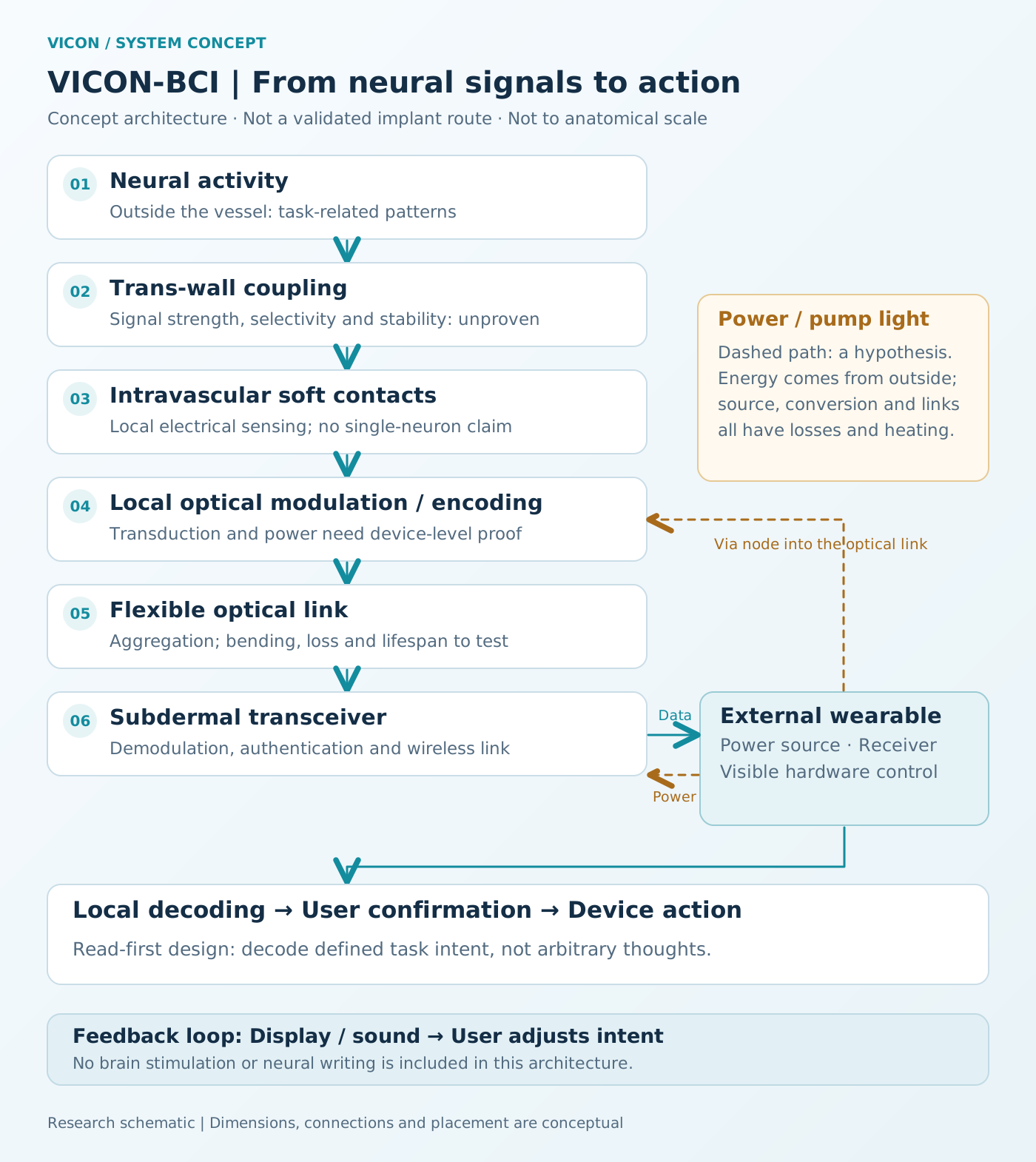
The sensing layer: soft contact, rigorous measurement
The first layer proposes a flexible interface combining PEG-type hydrogels with conducting polymers such as PEDOT:PSS. The hydrogel provides a hydrated environment and adjustable mechanical properties; the conducting polymer couples ionic signals to electronic devices. These are candidate material directions, not grounds for claiming that the complete device is a perfect match for a vessel wall. Research on PEDOT:PSS hydrogels provides a material-level foundation, while the composite intravascular contact proposed here would require its own validation.
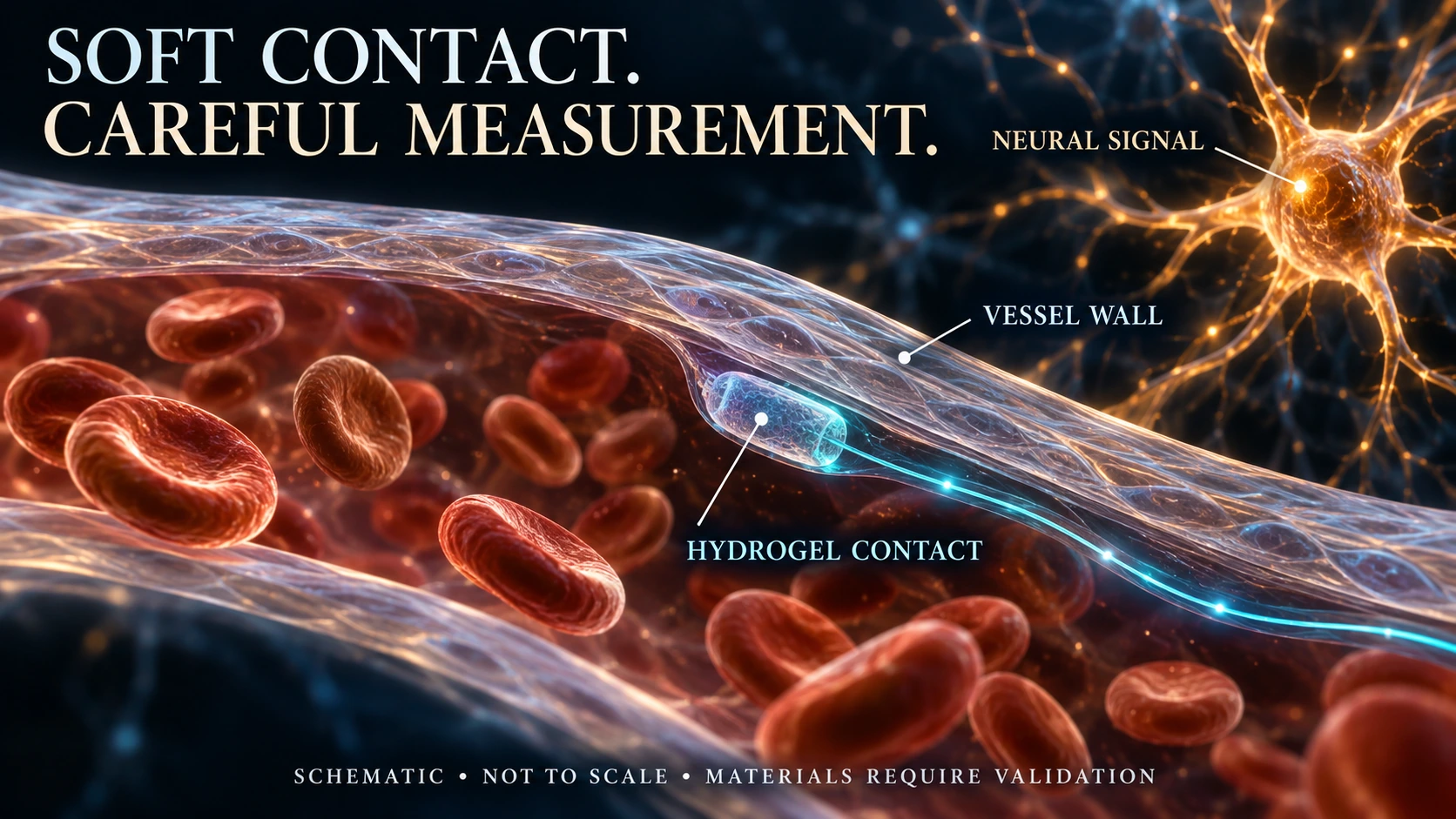
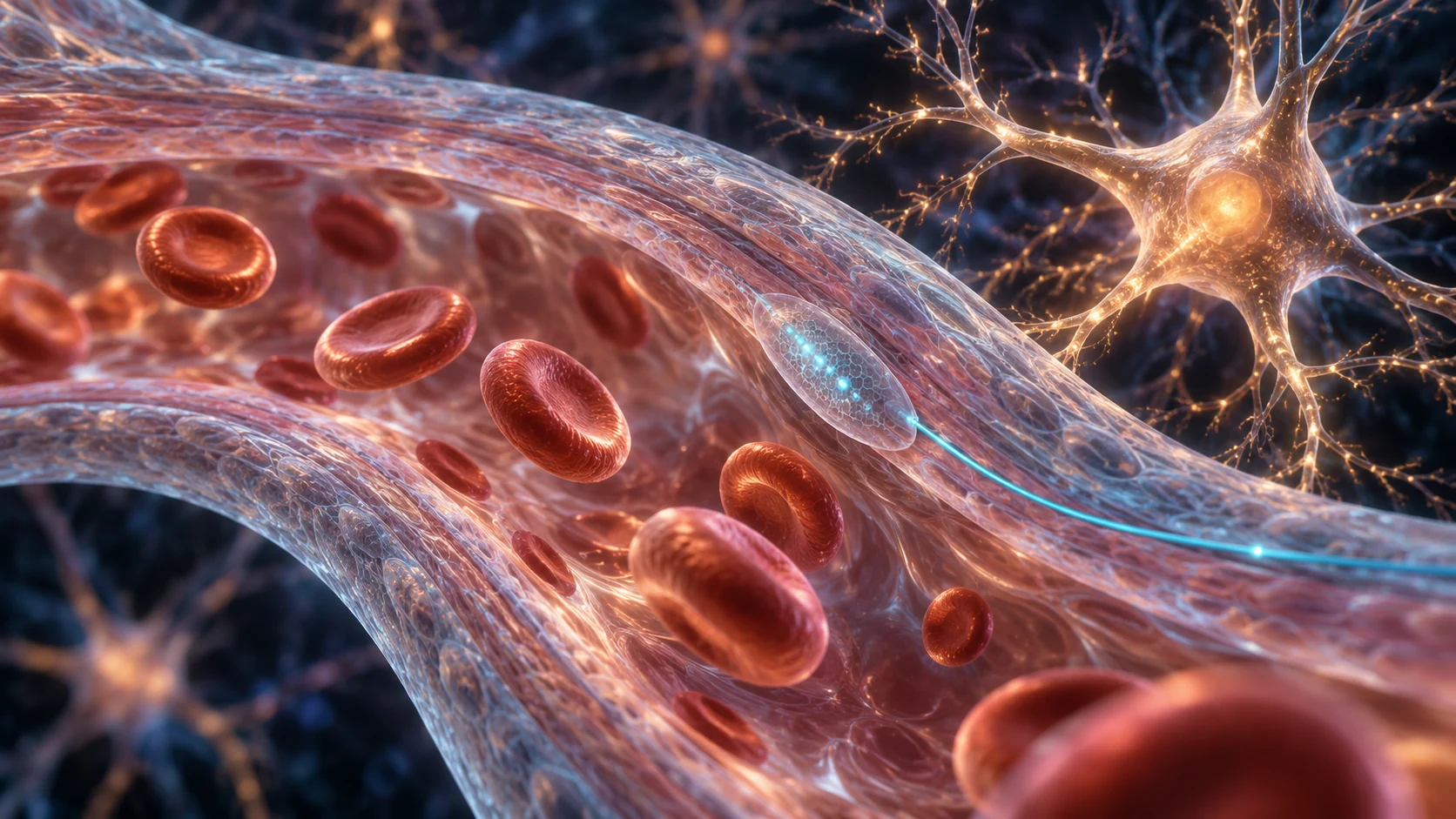
Neural activity occurs outside the vessel, while the contacts remain inside it. The aim is to record potential changes that remain distinguishable after propagation through surrounding tissue and vascular structures, rather than to pass neurons' ionic currents directly through the barrier. Contact area, interface impedance, blood-flow disturbances, distance from the neural source and motion artefacts all shape the resulting signal-to-noise ratio.
Antibodies or ligands could be explored as chemical aids to localisation, but “molecular Velcro” is only a metaphor. Target specificity, accessibility from the vessel lumen, binding under blood-flow shear and immune response would each need validation. An atlas of human brain vascular cells reveals differences in molecular expression; attaching a targeting molecule to a particle does not give it a reliable installation address for every brain region.
The transmission layer: optical connections with a complete power budget
The second layer proposes a flexible biological optical waveguide as a backbone, allowing local neural signals to modulate light and travel to a transceiver. Its operating principles come from optical sensing and communication; they do not require a “quantum fibre” explanation.
The missing component is a front end that can convert neural electrical signals into optical signals within strict space and power limits. A photodiode normally converts light into electricity. Simply attaching one to a sensing contact does not automatically reverse that process. Possible routes include optical resonators, electro-optic materials or miniature nodes containing amplification and encoding circuits. Each has size, noise and energy costs.
One relevant research anchor is a January 2026 preprint on graphene-based electro-optic sensors. Its authors report optical transduction of neural electrical signals and wavelength-division multiplexing of ten sensors on a single waveguide. This is a component-level proof of concept, not a peer-reviewed human endovascular system.
Wavelength-division multiplexing allows multiple signals to share a link, but assigning each contact a wavelength does not create unlimited capacity. Available spectrum, crosstalk, source stability, bending losses and addressing schemes all constrain scale. A reasonable direction to investigate is a combination of wavelength division, time division and regional readout, prioritising information that actually improves interaction.
“Spider-silk fibre” is an evocative description, but it cannot replace decisions about waveguide dimensions, refractive-index contrast and optical loss. Making a material thin, soft and durable while preserving reliable light transmission involves several competing requirements.
The transceiver layer: keep serviceable components accessible
A more ambitious version could place a demodulation chip in a superficial vein near the wrist, close to the wearable. The external device would then be easy to replace. However, a long intravascular fibre running from the cranium to the wrist introduces the challenges of neck and shoulder motion, venous valves and long-term fixation.
A more useful first version to investigate would place the transceiver at a manageable subcutaneous site, then compare connection routes for length, mechanical loading and removal conditions. An intravascular wrist anchor can remain a distant option, rather than an assumed anatomical route. The node would handle optical readout, any necessary digitisation, device authentication and external communication. Packaging and fixation are themselves parts of the system.
The interaction layer: a wristband with explicit permission to operate
The external wristband would coordinate power, communication and user control. Magnetic coupling or resonant power transfer, UWB or another short-range wireless protocol are candidate technologies. Selection would depend on losses through tissue, coil dimensions, changes in orientation and allowable temperature rise. Even if pump light travels from the transceiver back along the fibre to the sensing front end, the light source and modulators still consume energy.
The goal is therefore an implant without a battery, powered from outside the body. Individual sensing elements might be passive, but a complete recording, demodulation and wireless communication system cannot operate without energy. The wristband could decode signals locally and send only results explicitly selected by the user to a computer, phone or cloud AI. The 2025 MOTE study in mice demonstrated a miniature neural recorder with optical power and data transfer, while explicitly relying on electronic circuits for amplification and encoding. It offers inspiration and also shows why a battery-free system still needs a complete energy design.
03 · Cybernetics begins with knowing when not to act
A useful brain–computer interface needs a loop of intention, measurement, estimation, action and feedback. The user sees a cursor move or hears a confirmation tone, then adjusts the next intention. The system uses the resulting error to calibrate its decoder. A loop completed through sight and hearing does not require writing signals into the brain.
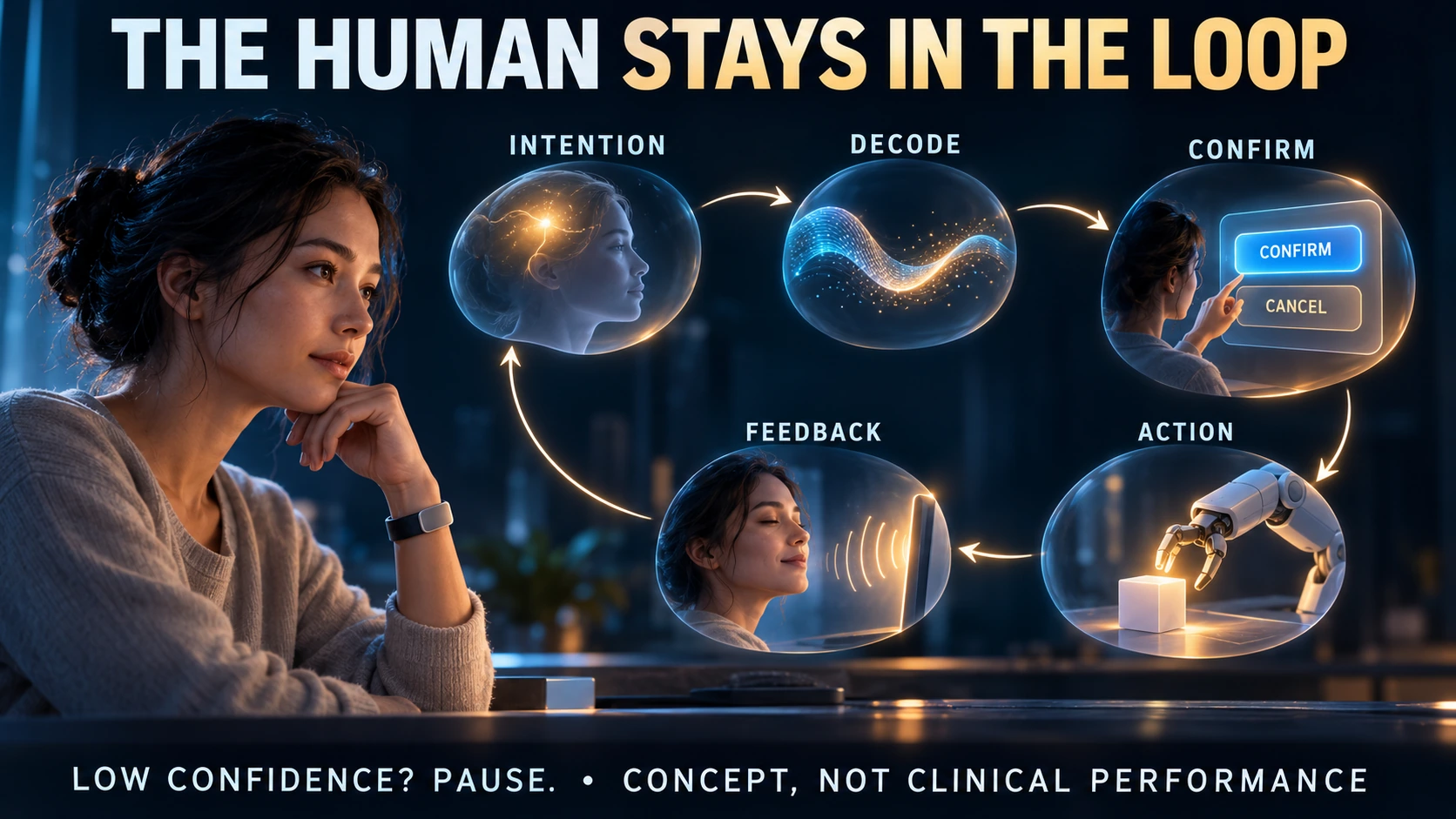
The difficulty is that both brain and algorithm are learning. Fatigue, changes in attention and contact drift can make yesterday's useful pattern unreliable today. A system that pursues only more channels and stronger predictions may conceal uncertainty behind apparently fluent operation.
VICON should begin with three control constraints: do not act on low confidence; require confirmation for consequential actions; and leave active operation for recalibration when signals continue to drift. Payments, messages and control of physical devices should not proceed automatically on the strength of one ambiguous neural classification.
AI can help complete a sentence, but the interface should distinguish the user's explicit selections from the model's suggestions. Evaluation should likewise report raw decoding performance separately from the benefits of language-model completion. Otherwise, “writing faster” may conceal “guessing more.”
04 · A complete lifecycle: entry, coexistence and exit
Entry: from controlled placement to controlled assembly
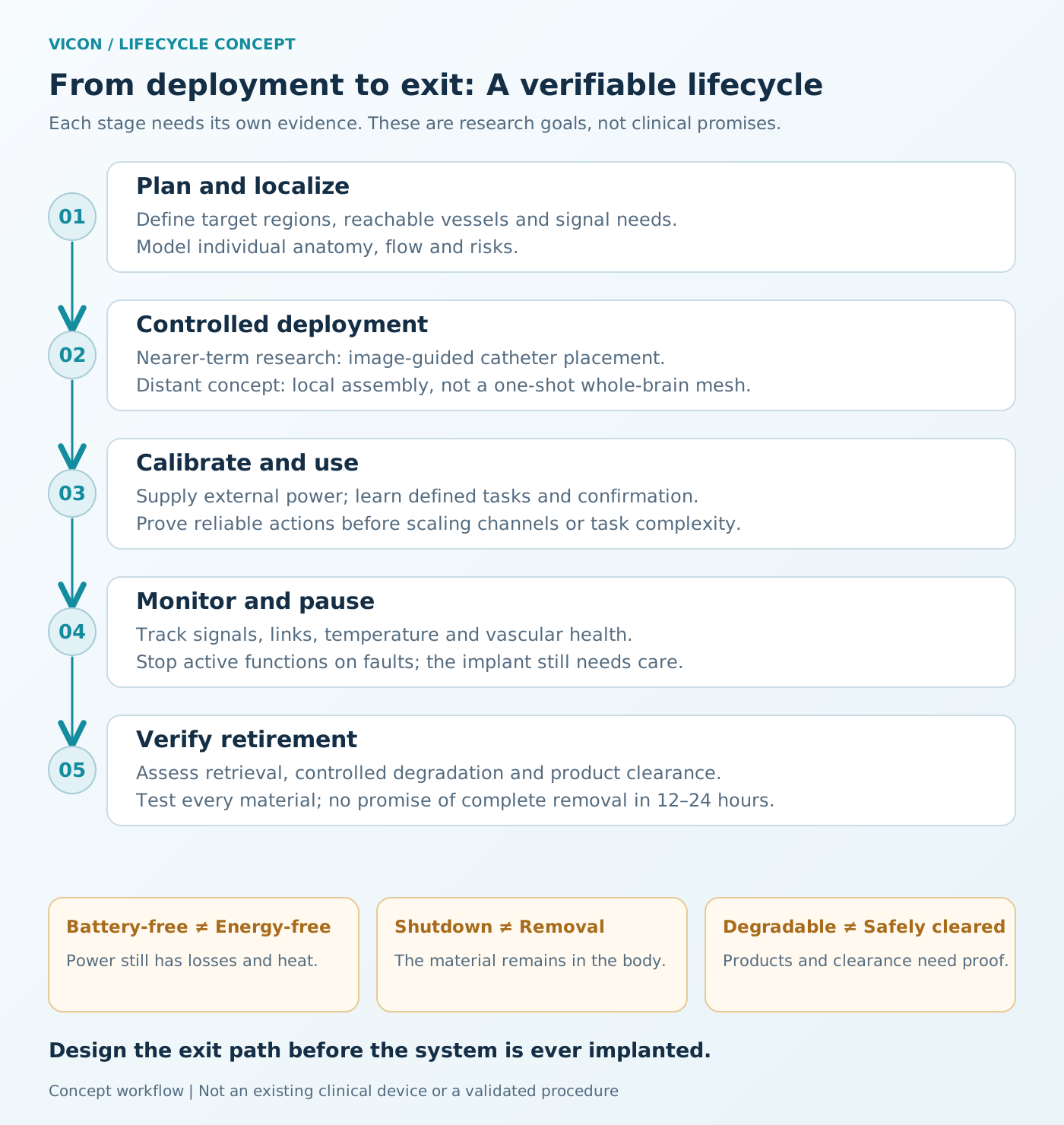
The nearer-term question is how imaging and catheter guidance could position a limited number of flexible devices in selected vascular regions. Chemical binding or local assembly at the target site belongs to a more distant vision.
Progress toward injectable, distributed hardware first requires validated mechanisms for transport, localisation and connection. Peripheral venous blood returns first to the right heart and pulmonary circulation. It does not flow directly through cerebral veins into brain capillaries. A magnetic field does not automatically solve branch selection, device entanglement or obstruction.
Deployment speed should be established experimentally once these mechanisms mature, without assuming a thirty-minute whole-brain installation. The questions to establish are where each node is, how it connects, whether it impedes blood flow and how it can be recovered if deployment fails.
Coexistence: begin with a small, useful feedback loop
Everyday use would begin with calibration. The user practises a small set of distinguishable intentions, and the system learns stable signal features before progressively enabling clicks, selection, text input and assistive device control. Expansion should depend on whether additional nodes deliver reliable benefits.
Removing the wristband or withdrawing permission could stop external power and active communication. The design should also address residual stored energy, unintended wake-up and loss of connection. Meanwhile, the implant remains in the body, and vascular responses do not pause when the device is switched off. Device state and biological state require separate monitoring.
Exit: turn degradability into a set of testable questions
Research on bioabsorbable polymer optical waveguides gives us reason to imagine hardware with a finite lifetime. Its tissue photomedicine and materials experiments, however, do not establish an intravascular neural network. Hydrogels, waveguides, conducting polymers, chips, metals and packaging do not naturally share one degradation pathway. Showing that one material hydrolyses does not imply that an entire system becomes water and amino acids.
In VICON's research programme, retirement should be separated into stopping function, retrieval where needed and validated material degradation. A chemical trigger would require evidence that it reaches every target, acts selectively and does not generate intermediate fragments that cause embolism, inflammation or an excessive burden on organs.
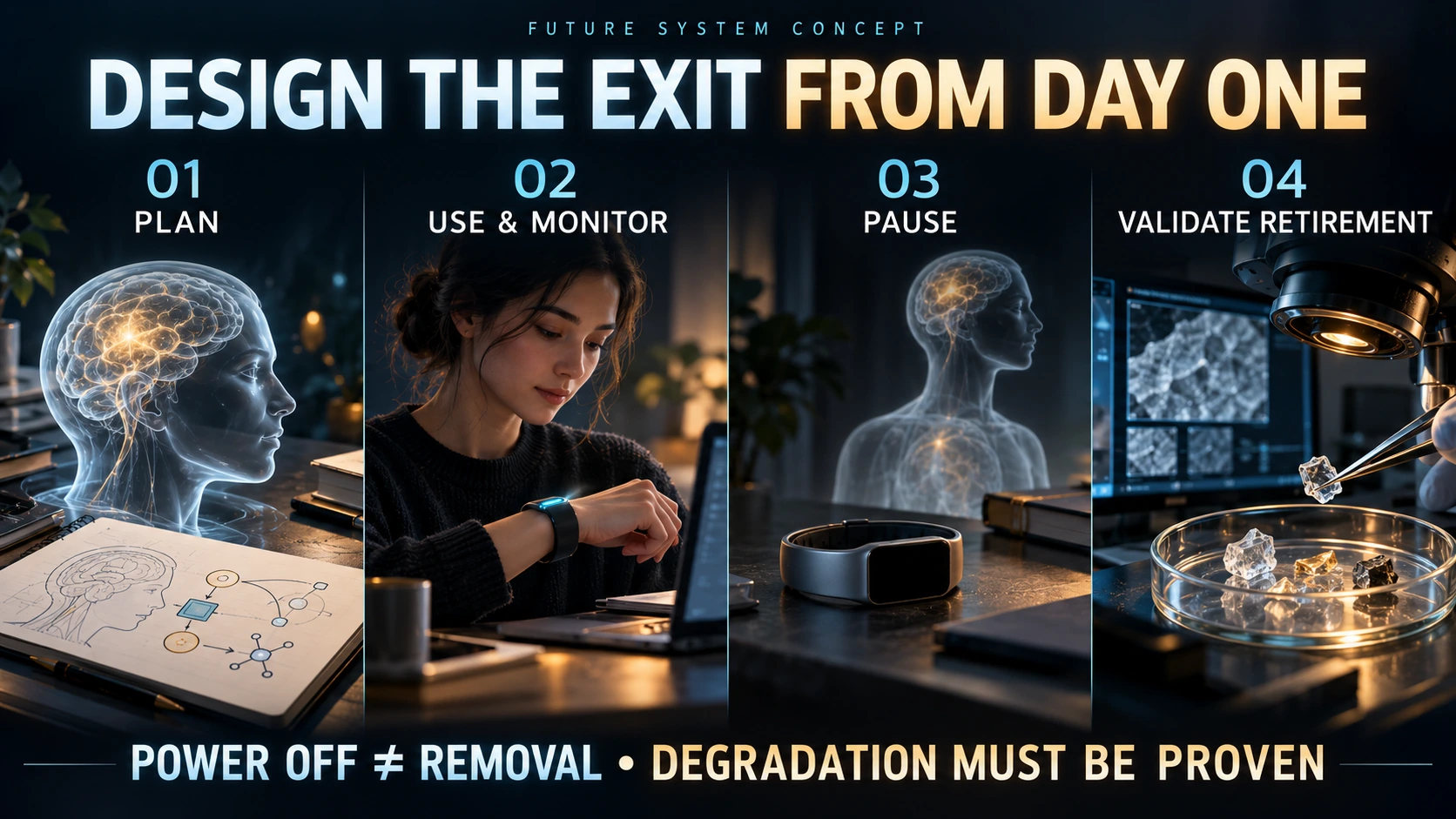
The retirement window and clearance pathways must be established through research. There is currently no basis for promising complete clearance within twelve to twenty-four hours. A more useful goal is to establish the fate and toxicology of every material class and identify which components must be retrieved. The ability to exit should be a verified outcome, not an adjective attached to a material.
05 · Safety requires a design for failure
Softness, hydrophilicity and low power consumption are meaningful design directions, but none establishes safety on its own. VICON's risks span vascular biology, mechanical reliability, thermal management and software permissions.
| Boundary to protect | Design direction | Evidence required |
|---|---|---|
| Vessels and blood–brain barrier | Reduce mechanical injury and control the space occupied by devices | Long-term vessel patency, barrier function and tissue response |
| Thrombosis and embolism | Blood-compatible surfaces, reliable fixation and limited fragment shedding | Coagulation, haemolysis and long-term observations under relevant flow conditions; no coating guarantees zero thrombosis |
| Heat and power | Limit average and peak power, read regions selectively and cut power during faults | Local temperature rise in adverse orientations and fault conditions; low optical power does not mean zero heat |
| Neck and shoulder motion, and service life | Minimise spans across joints, provide strain relief and monitor the link | Bending, fatigue, migration, package ageing and optical loss |
| Unintended actions and privacy | Local processing, authenticated encryption, minimal permissions and user confirmation | False activation rates, cancellation, key management and update security |
| Pause and retirement | Stop active functions and provide a route for retrieval or validated degradation | Safety after connection loss, material fate, residues and toxicology |
Privacy, in particular, cannot be entrusted to the word “quantum.” An ordinary optical fibre does not automatically provide quantum key distribution, nor does a third party reading data necessarily produce a detectable change in photon states. Even a dedicated quantum communication protocol cannot replace endpoint, firmware and permission management. The NSA's explanation of QKD implementation limits also makes clear that quantum key distribution addresses only part of a security system and still requires authentication.
More concrete design commitments for VICON would be that the user can stop acquisition; raw signals are processed locally by default; permission can be revoked; updates must be verified; and any future neural stimulation function is reassessed as a separate capability. An initially read-only design limits the actions the system can take, while still requiring safeguards against incorrect decoding and data misuse.
06 · Building toward abilities that matter
VICON's first destination could be a reliable “yes” and “no” for someone who has lost dependable motor control. Next might come cancellable clicks, trainable cursor control and assisted writing in which the user retains the final decision. Richer interactions can follow as signals, materials and control methods improve.
Complex games and long-form writing impose different demands. Games demand continuous control, consistent latency and resilience to interference between tasks. Writing places greater emphasis on accurate selection, the cost of correction and fatigue during extended use. Neither follows automatically from “a million contacts” or “high-speed fibre.”
If choosing the first problem to solve, I would prioritise whether signals recorded across vessel walls can provide stable, repeatable and useful control under conditions of long-term safety. Transmission bandwidth can carry data, but it cannot recover information that was never captured at the sensing interface. Fibre flexibility and service life must be validated alongside this work, because mechanical stability also affects signal quality.
The research sequence should be explicit: validate interfaces, blood flow and optical links in models and bench studies; assess recording quality, material responses and retrieval conditions in appropriate preclinical studies; and only then, if requirements are met, consider regulated early human research. At every stage, a valid conclusion may be to narrow the scope, change the approach or stop.
A meaningful performance report would include task success, false activations per hour, the distribution of end-to-end latency, calibration burden, long-term signal drift and vascular and tissue safety outcomes. These measures must come from actual studies. This article assigns no invented values to a system that does not yet exist.
07 · Future interfaces should preserve the right to disconnect
The most compelling part of VICON is its attempt to make the machine accommodate the body: softer materials, more controllable power, an easier way to stop connecting, and a place for retirement from the outset.
Its destination need not be an entire brain connected to the cloud. A more valuable future may be one in which a person can independently write a sentence again, finish a game or turn off a screen without assistance. The system understands one explicit intention and leaves the rest of that person's inner world to them.
The most important advance in brain–computer interfaces would then include more than how much information we can transmit. It would also include our ability to decide when to connect, what to express and when to finish.
Research anchors and how to read this proposal
This article distinguishes existing research, engineering judgments inspired by that research and long-term speculation. The sources below support specific device or material directions, not the complete VICON system. This is not an exhaustive systematic review of all research available at publication.
- Mitchell et al., 2023, the SWITCH endovascular brain–computer interface study, JAMA Neurology. Evidence level: a small human study.
- Zhang et al., 2023, ultraflexible micro-endovascular neural probes, Science. Evidence level: rodent research.
- Lu et al., 2019, Pure PEDOT:PSS hydrogels, Nature Communications. Evidence level: materials research.
- Nizamoglu et al., 2016, bioabsorbable polymer optical waveguides, Nature Communications. Evidence level: materials and preclinical research.
- Lee et al., 2025, a miniature optoelectronic system for chronic neural recording in awake mice, Nature Electronics. Evidence level: animal research, without endovascular deployment.
- Ahmed et al., 2026, graphene-based electro-optic sensing for optically multiplexed neural recording, arXiv:2601.04354. Evidence level: a proof-of-concept preprint.
- Yang et al., 2022, a human brain vascular cell atlas, Nature. Evidence level: basic biological research, not validation of targeted device deployment.
- US National Security Agency, technical limitations of quantum key distribution and quantum cryptography. Cited for communication security boundaries, not VICON's medical effectiveness.
25 October 2026 · A future technology proposal. VICON-BCI is the concept name used in this article. The opening scene is imagined; illustrations are AI-generated and architecture diagrams were designed for this proposal. No VICON prototype, human trial or measured performance is reported.