TopxAI
Opening page
Opening page
Loading insights
Read the disclosures. Understand the business behind the numbers.
A bitcoin miner books the coins it mines as revenue, but coins are not cash, and the proceeds from selling them can sit in investing activities. Operating cash flow is therefore negative by construction. Using ten quarters of Riot Platforms filings, this piece lays out three lines to read side by side, and explains why a widely quoted non-GAAP figure swings with the bitcoin price.
Read the analysis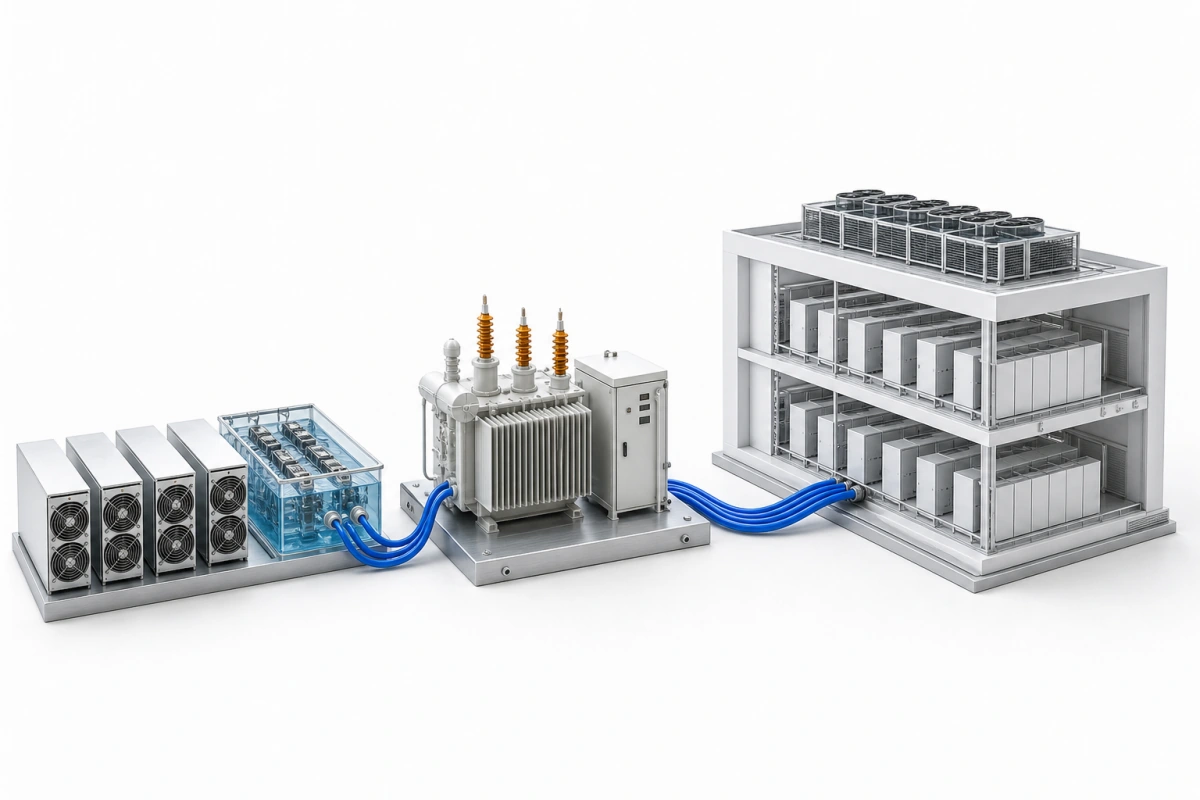
Compound today's price at the required return to the end of 2029, divide by the current forward multiple, and the 2030 EPS that comes out tends to be called “price-implied”. But that multiple is itself price divided by consensus, so the price cancels and the reading is simply consensus compounded at the required return. Using FormFactor's numbers, this piece shows the trap, how to check for it, and where the price information actually sits.
From early 2025 to June 2026, Applied Optoelectronics raised $1.547bn net by selling stock at the market, 97.3% of its external funding; customers prepaid nothing. This piece rebuilds a sources-and-uses ledger for that money by differencing year-to-date cash-flow figures, flags three places where pulling XBRL tags in bulk gets it wrong and one where the 10-K text reports a single month as a whole round, and compares where the peers found their expansion money. All of it can be reproduced from public filings.
A GPU owner that rents out compute can have the same set of customer contracts split across ASC 606 and ASC 842: one set goes into RPO, the other does not. IREN's 10-K spells out the split, yet anyone reading RPO alone sees a third of it. This piece shows where to find both sets in the filings, the two XBRL tags that mislead, and how the peers compare.
Data-center landlords' press releases talk about "contract value"; the accounting standard recognizes only "minimum lease payments receivable on commenced leases". At TeraWulf the two numbers differ by almost twenty times. This piece shows where to find the second one in a 10-Q, why it is harder than contract value, and why the same company reports capacity in two MW bases at once. Reproducible, no paid data.
Make blue dots rare and people start calling purple ones blue. An oystercatcher will abandon its own egg for a more egg-like fake. AI need not replace you; it only has to nudge "normal" upward a few dozen times a day. We name that half CCAA and give an experiment that could start tomorrow.
Six-fold disagreement on one question — definitional, not a research-quality problem. The alternative: build it bottom-up from three quarterly-filed AI revenue lines.
We parsed all 90 of Vertiv's (NYSE: VRT) Forms 4 over twelve months, 150 transactions, one at a time. Strip out cashless exercises and net accumulators and the usable figure is $100.8m — of which 91.9% came from the board, while the CEO and CFO sold nothing. Reproducible steps included.
For ten consecutive quarters Vertiv disclosed order growth, book-to-bill and backlog every quarter. In Q4 2025 those read +252%, 2.9x and $15.0bn — and on the same call management announced they would no longer be reported quarterly; both releases since count zero. Includes the reproducible method, and the trap that produces the opposite conclusion if you skip it.
We pulled and read both of Palantir's 20 August Forms 144. A Form 144 is a notice of intent, not a sale; one filing names its 10b5-1 adoption date and the other leaves the field blank — and that field is where all the information sits. Plus a share-count trap that understates price-to-sales by 4.3%.
A coding agent on claude-sonnet-5-5, usage assumed: $99 a month on the shared pool, $178.2 on the official line, $198 at list. Claude, GPT and Grok compared line by line. Sonnet 5.5 prices updated 2026-10-02; other models remain a 2026-09-12 historical snapshot. The live catalogue governs.
Point the OpenAI and Anthropic SDKs, Claude Code and Codex at TopxAI for Claude, GPT and Grok; pick the official line or the shared pool; cap the key. Sonnet 5.5 setup and prices updated 2026-10-02. Other models remain a 2026-09-12 historical snapshot; see the live catalogue for current prices.
Quantum Queen X v4.3 ships 51 literal historical dates baked into its source: 24 on which it refuses to trade, 8 that multiply the take-profit by 15, and 19 that multiply it by 5. All are past dates and the last sits right at the build date — they can only rewrite backtests, never a future session. Here is the original code, line by line, and why this is cheating rather than optimisation.
The Gold Reaper is that rare gold EA with no grid, no martingale and a stop loss on every trade. The author's live signal has run 92 weeks: +261.56%, 71.95% win rate, 16.05% max drawdown. Here's how the strategy works, how to read that record, and who it does and doesn't suit.
UBS runs dozens of independent breakout sub-strategies from a single chart. Live at 11 weeks: +16.18%, 543 trades, profit factor 1.27, 11% max drawdown. More important than the numbers: without the autoloader your backtest will be wrong — which is how this EA gets misjudged.
Lizard is a six-strategy XAUUSD breakout system — no martingale, no grid, a stop on every trade, $250 minimum. Live at 12 weeks: +65.59%, 112 trades, 14.74% max drawdown. But the most useful thing about it is how much those numbers moved between week 9 and week 12.
Perceptrader AI uses a neural network to filter signals, but underneath it is still a grid. What makes it unusual is the live record: 173 weeks, +341.04%, 6,602 trades, 17.06% max drawdown. Here's the real structure, how to read that record, and whether you can live with grid risk.
Full Throttle DMX spreads 10 strategies across 5 currency pairs, no grid or martingale. 18 weeks live with a 48.36% win rate — and still profitable. This review explains why a sub-50% win rate doesn't mean losing money, and what its diversification actually diversifies away.
Gold Snap is the newer sibling to Gold House, built to take profit faster. It rates 5.0 on MQL5 (18 reviews) — but the author's own live signal is only 2 weeks old. This piece breaks down the strategy and how to actually read a brand-new signal.
Sharkyra Gold rates 4.1 with 10 reviews, pitching an M5 gold scalper with claims of 'no dangerous strategy' and low drawdown. This review is about not taking the copy at face value — how to verify it yourself, and how to read 'only 10 copies left' urgency tactics.
Nexorion rates 5.0 with 12 reviews and markets 'institutional-grade liquidity analysis' with no martingale or grid. This review translates the BSL/SSL and Equilibrium jargon into plain English, and reads into what a low activation cap implies.
Wave Rider rates 4.97 with 34 reviews — solid word-of-mouth. A neutral breakdown: how the four-strategy scalper works, what 'intelligent recovery' really is, the gap between single-position and grid modes, and what 15 weeks live is worth.
MSC Gold Pro's live max drawdown is just 5.39% — low for a gold EA. A neutral breakdown using its public MQL5 record: strategy, what the low drawdown really means, risks, and who it fits.
Quantum Queen is one of the top-rated gold EAs on MQL5. We break down its strategy, live performance, who it fits, and the risks you must know.
Quantum Emperor is another gold EA from Bogdan Ion Puscasu, built around a concentrated single-position style. We break down strategy, fit and risk.
Quantum Athena is one of the few in the Quantum family that explicitly avoids martingale. We break down its strategy, account requirements and risk.
Quantum King trades AUDCAD (not gold), starts at $300, but uses grid + martingale. We spell out the risk behind the low entry.
Quantum Bitcoin runs a BTCUSD trend grid with a "every cycle ends in a win" claim. We break down the strategy, requirements, and that marketing line.
Pulse Engine is a rare single-entry, hard-SL, no-grid/no-martingale time-of-day pattern EA across 6 markets. A professional breakdown of its mechanism, real risk, and what to interrogate.
Smart Owl is an Asian-session mean-reversion night scalper with hard SL. A professional take on why its real risk is execution and spread, not a blow-up.
TwisterPro is a gold breakout stop-entry scalper, no grid/martingale, rejecting ~99% of setups. A professional take on mechanism, flat periods and raw-spread dependency.
Legendary markets 12+ strategies behind a 5-layer filter as 'AI collective intelligence,' but its core position management is grid + lot advancement. A professional look at the framing-vs-mechanism gap.
Waka Waka is a long-standing AUD-cross martingale grid that's frank about its mechanism. A professional take on why its high-return story must be read with the 50-72% drawdown.
We read every line of Quantum King 3.1's MQL5 source and compiled it. No licence checks, no trial timer, no hardcoded date tables — which is rarer than it should be. But it attaches no stop loss by default and every account-level guard ships disabled. Here's the mechanism and the boundaries.
Same EA, same .set, two different equity curves. We isolated the chart timeframe in a controlled test: 60× the bar count, and every figure in both reports came back identical. The variables that actually move the number are elsewhere — ranked by impact, with our own measured data.
“30% a month”, “10× in three months” — almost always a trap. Using monthly return, drawdown, compounding and real live ranges, this explains what an EA can realistically be expected to make at sane risk, and how to spot the ‘high-yield’ setups destined to blow up.
Could an EA run off with your money? Bottom line: a licensed EA can't — it places trades in your account but never touches deposits or withdrawals. The real risks are malware in pirated builds and scammers asking for your master password. Here's what an EA can and can't do, and how to use one safely.
Put all your capital in one EA and one blow-up takes everything. A basket of 3–5 low-correlation EAs is how steady traders play it. Here's how to combine by strategy, symbol and correlation — and how many is right.
Once you can spot fakes on Myfxbook, the next step is understanding what each metric means: why Gain differs from absolute gain, the types of drawdown, what Profit Factor is good, and why a high win rate can be a trap.
Gold (XAUUSD) spreads are wide and variable, and most gold EAs are high-frequency scalpers — extremely spread-sensitive. This breaks down the true cost of a trade and explains why a pretty backtest shrinks live.
Weekend gaps and big news like NFP/FOMC blow spreads up several-fold and make slippage wild. Whether to pause depends on your EA's strategy — here's a decision table by type, plus the practical settings.
Beginners pick EAs by return; veterans look at drawdown first — return decides how much you make, drawdown decides whether you survive long enough to make it. Four steps to a genuinely low-drawdown EA.
Saving a few hundred dollars on a cracked EA risks your whole trading account and PC. The five landmines: hidden backdoors, broken cracks, tampered logic, no updates, and scam sources.
Copy trading buys someone's judgment; an EA buys a fixed rule set. Where each can fail you, and which path fits which person.
An EA must run 24/7, so a VPS is unavoidable infrastructure. Why latency is the first metric, how to size specs, and four common pitfalls.
MT5 is better on backtest accuracy, multi-asset and performance — and it's the future for EAs. The differences, and how to choose by the EA you want.
The danger is real — but dangerous isn't the same as a scam. The risk structure of grid/martingale, when it's usable, and when to never touch it.
Capital isn't 'more is better' — it must match the strategy's drawdown profile. Grids need thick funding; single-entry stop systems can be thin. Reference ranges and the math.
Yes — but not every EA, and not the way you think. An honest breakdown of why most people lose with EAs, and which ones are worth touching.
Most managed/copy services show you only the equity curve. We published the deepest drawdown instead: here's why, and how to read that number.
A prop firm challenge is won on drawdown rules, not on returns. Which EA structures fit the rules, which are almost designed to fail them, and a selection checklist.
Gold is the most popular and the most punishing symbol for EAs. Here are 5 criteria, plus how our gold EAs differ and who each fits.
Most EA marketing sells a narrative, not a track record. These 8 red flags filter out the majority of scams before you pay.
The biggest trap when buying an EA is faked backtests and Photoshopped P&L. Here's how to verify a real track record with Myfxbook in four steps.
After buying an EA: rent a VPS and run it yourself, or hand it to a managed service? A side-by-side of real cost, skill, and risk.
Always backtest in your own environment before going live. A step-by-step on the MT5 Strategy Tester and the backtest traps to avoid.